Sound Advice

Car Codes of Conduct

Since its inception, the primary purpose of the automobile has always been to provide venue for pastors to lose their testimonies. It may also (as a strictly secondary function) provide some modicum of useful transportation.

It is a well known fact in fundamentalism that even the most restrained and moderate of people lose all self-control once they set foot in a motor vehicle. Unless carefully monitored, riding in a car with a member of the opposite sex can lead to fornication, drunkenness, and head-on collisions with trains — possibly all three at the same time.

In the interest of preventing these unfortunate occurrences, the following rules should be observed by any fundamentalists who intends to travel by automobile.

– Pastors should never enter a car with a woman. Ever. If that means leaving her to be eaten by wolves then so be it. Your ministry is too important to risk.

– If two people who are dating should happen to need to travel together for sanctioned ministry purposes such as traveling too and from Bible college, they must travel in no smaller vehicle than a 15 passenger van and be seated for maximum separation distance between them. Please consult the following chart:
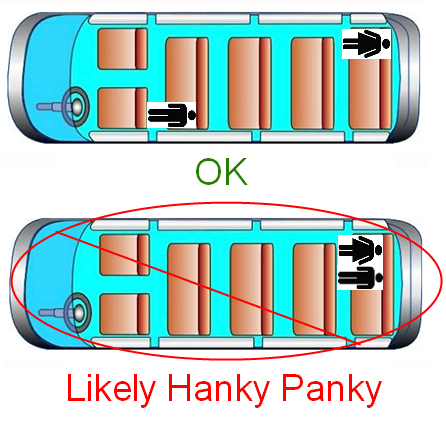
– If two people are currently pretending not to be dating so they can sit together on the long, long missions trip to Mexico they must be separated at all times by the width of a King James Bible (Wide Margin, Oxford Press, 1769 edition, 3rd printing).

– Chaperons shall be strategically placed in the vehicle in such a manner that all hands, feet, elbows, and knees are in plain view at all times. If a chaperon is unavailable this task may be relegated to a child who has demonstrated great alacrity in the tattling department.

– Every trip shall begin with a prayer in which the driver shall make it clear to all within earshot that the continued safety of all passengers from accident or freak avalanche depends on the above rules being kept with utmost vigor.

Observe these rules well and it may be possible to keep the inevitable vehicular orgies to a bare minimum. And keep an eye out for those oncoming trains.

Posted by Darrell @ http://www.stufffundieslike.com

Quote of the day…

“I have realized that the past and future are real illusions, that they exist in the present, which is what there is and all there is.”

– Alan Watts

Interluding Around

Interlude Repeated

Who Owns You?

Over the last 20 years, the United States Patent and Trademark Office has been issuing patents to universities and private companies on raw human genes. One company or university is given a legal monopoly over a molecule that is inside every human being and many other animals. This documentary explores the legal, ethical, and clinical ramifications of human gene patenting

via Who Owns You? – A Documentary – Trailer on Vimeo.

Record grooves under an electron microscope

Chris Supranowitz is a researcher at The Insitute of Optics at the University of Rochester. Along with a number of other spectacular studies (such as quantum optics, trapping of atoms, dark states and entanglement), Chris has decided to look at the relatively boring grooves of a vinyl record using the institute’s electron microscope. Well, not boring for me.

From what I read, it’s not just a simple matter of sticking a record under a fancy microscope, as there is a lot of preparation (such as gold-sputtering the surface) and post-processing to be done. Having said that, the results are very cool:

Here is a shot of a number of record grooves (the dark bits are the top of the grooves, i.e. the uncut vinyl):

Here’s the grooves closer up – the little bumps are dust on the record:

And here’s a single groove even closer still, magnified 1000 times:

Chris also did the pits in a CD – here’s what they look like, just for contrast:

Chris decided to take the whole electron microscope image one step further, and created a blue/red 3-dimensional image of the record groove! So, if you have a pair of 3D glasses (sorry, the ones you got from watching Avatar won’t work – you need red on the left, blue on the right), throw them on and take a look at this amazing picture:

Via: SYNTHGEAR  Record grooves under an electron microscope.

As you can tell …

… I decided to change the theme of the blog.

Although I liked the dark look I found the grey letters on a black background and small font increasingly hard to read.

This theme, although a little more inappropriately cheery, seems a little more visually friendly.

Hope you guys like it … please let me know if you don’t and I’ll either change it back or find a new one.

Big Love!

Serge

MC Escher panorama

Click Mr. Linky for a Tribute to Escher

So good …

Transatlantic Interlude

How true!

“… people are much more likely to listen to you when you are dressed as a giant banana.”

via: RSA Projects.

DREAM-LOGIC, THE INTERNET AND ARTIFICIAL THOUGHT

“What does it mean to think?  Can machines think, or only humans? These questions have obsessed computer science since the 1950s, and grow more important every day as the internet canopy closes over our heads, leaving us in the pregnant half-light of the cybersphere.  Taken as a whole, the net is a startlingly complex collection of computers (like brain cells) that are densely interconnected (as brain cells are).  And the net grows at many million points simultaneously, like a living (or more-than-living?) organism.  It’s only natural to wonder whether the internet will one day start to think for itself.

(Or is it thinking already?)

These questions are important not only to the internet but to each individual computer.  Computers grow more powerful all the time.  Today, programs that are guided not just by calculations but by good guesses are important throughout the software landscape.  They are examples of applied artificial intelligence — and the ultimate goal of artificial intelligence is to build a mind out of software, a thinking computer — a machine with human-like (or super-human) intelligence.

In a way these possibilities are frightening, or at least thought-provoking.  But after all, human intelligence is the most valuable stuff in the cosmos, and we are always running short.  A computer-created increase in the world-wide intelligence supply would be welcome, to say the least.

It’s also reasonable to expect computers to help clean up the mess they have made.  They dump huge quantities of information into the cybersphere every day.  Can they also help us evaluate this information intelligently?  Or are they mere uncapped oil wells pumping out cyber-pollution — which is today just a distraction but might slowly, gradually paralyze us, as our choices and information channels proliferate out of control?  As each of us is surrounded by a growing crowd of computer-paparazzi all shouting questions and waving data simultaneously, and no security guards anywhere?

Here is an unfortunate truth: today’s mainstream ideas about human and artificial thought lead nowhere.

We are trapped by assumptions that unravel as soon as we think about them: “we” meaning not only laymen but many philosophers and scientists. Here are three important wrong assumptions.

Many people believe that “thinking” is basically the same as ‘reasoning.'”

More at:  Edge: DREAM-LOGIC, THE INTERNET AND ARTIFICIAL THOUGHTBy David Gelernter.

An Agnostic Manifesto

“Let’s get one thing straight: Agnosticism is not some kind of weak-tea atheism. Agnosticism is not atheism or theism. It is radical skepticism, doubt in the possibility of certainty, opposition to the unwarranted certainties that atheism and theism offer.”

More at:  The rise of the new agnostics. – By Ron Rosenbaum – Slate Magazine.

Quote of the day…

“To achieve harmony in bad taste is the height of elegance.”

– Jean Genet

Jet-lagged Interlude

Race Doesn’t Exist. Or Does It?

An interesting podcast:

WNYC – Radiolab: Race Doesn’t Exist. Or Does It? (November 28, 2008).

Odd desire …

My father has lived in the 14eme arrondissement for a long time … it is a wonderful neighborhood which includes the Montparnasse Cemetery.  Many extraordinary folks are resting within its walls, and although it is no more than a five minute walk from his apartment I have never been moved to visit it.  I have a rather indifferent view of cemeteries in general … they are fundamentally anachronistic and have always seemed humorously irrelevant to me.

But I think I’ll take a stroll over there tomorrow … maybe to meet some folks long gone, maybe to escape the infernal drilling down the street.

On the subject of just seeing with eyes

click on the picture and …

Just because …

Quote of the day…

“There’s no problem, only teachers”

– Jacques Prévert

Amor Fati – The Embracing of an Undecided Fate

http://www.nietzschecircle.com/Nietzsches_Amor_fati.pdf

“Amor fati is a Latin phrase coined by Nietzsche loosely translating to “love of fate” or “love of one’s fate”. It is used to describe an attitude in which one sees everything that happens in one’s life, including suffering and loss, as good. That is, one feels that everything that happens is destiny’s way of reaching its ultimate purpose, and so should be considered good. Moreover, it is characterized by an acceptance of the events or situations that occur in one’s life.”

via Amor fati – Wikipedia, the free encyclopedia.

Is this something or is this nothing?

So I’m watching this, and it’s very pretty I guess … unless you’re Buddha of course and the whole pebble in the lake thing becomes metaphor FAIL!

Ugh … there’s consequentialism for you …

Looks expensive.  🙂

I believe in the radical possibilities of pleasure (I do, I do, I do)

“The only sex that is unfeminist is sex that any of the people involved don’t want to be having. There is no particular meaning in a blowjob. You are not sending a political message by having anal sex. What I do in my bedroom is not preventing the Revolution from happening.”

via:  I believe in the radical possibilities of pleasure (I do, I do, I do) — Feministe.

Consequentialism

Consequentialism, as its name suggests, is the view that normative properties depend only on consequences. This general approach can be applied at different levels to different normative properties of different kinds of things, but the most prominent example is consequentialism about the moral rightness of acts, which holds that whether an act is morally right depends only on the consequences of that act or of something related to that act, such as the motive behind the act or a general rule requiring acts of the same kind.

cont …

What is Consequentialism?

This array of alternatives raises the question of which moral theories count as consequentialist (as opposed to deontological), and why. In actual usage, the term ’consequentialism‘ seems to be used as a family resemblance term to refer to any descendant of classic utilitarianism that remains close enough to its ancestor in the important respects. Of course, different philosophers see different respects as the important ones. Hence, there is no agreement on which theories count as consequentialist under this definition.

To resolve this vagueness, we need to determine which of the various claims of classic utilitarianism are essential to consequentialism. One claim seems clearly necessary. Any consequentialist theory must accept the claim that I labeled ‘consequentialism’, namely, that certain normative properties depend only on consequences. If that claim is dropped, the theory ceases to be consequentialist.

It is less clear whether that claim by itself is sufficient to make a theory consequentialist. Several philosophers assert that a moral theory should not be classified as consequentialist unless it is agent-neutral (McNaughton and Rawling 1991, Howard-Snyder 1994, Pettit 1997). This narrower definition is motivated by the fact that many self-styled critics of consequentialism argue against agent-neutrality.

Other philosophers prefer a broader definition that does not require a moral theory to be agent-neutral in order to be consequentialist (Bennett 1989; Broome 1991, 5-6; and Skorupski 1995). Criticisms of agent-neutrality can then be understood as directed against one part of classic utilitarianism that need not be adopted by every moral theory that is consequentialist. Moreover, they argue, the narrower definition conflates independent claims and obscures a crucial commonality between agent-neutral consequentialism and other moral theories that focus exclusively on consequences, such as moral egoism and recent self-styled consequentialists who allow agent-relativity into their theories of value (Sen 1982, Broome 1991, Portmore 2001, 2003).

A definition solely in terms of consequences might seem too broad, because it includes absurd theories such as the theory that an act is morally right if it increases the number of goats in Texas. Of course, such theories are implausible. Still, it is not implausible to call them consequentialist, since they do look only at consequences. The implausibility of one version of consequentialism does not make consequentialism implausible in general, since other versions of consequentialism still might be plausible.

Besides, anyone who wants to pick out a smaller set of moral theories that excludes this absurd theory may talk about evaluative consequentialism, which is the claim that moral rightness depends only on the value of the consequences. Then those who want to talk about the even smaller group of moral theories that accepts both evaluative consequentialism and agent-neutrality may describe them as agent-neutral evaluative consequentialism. If anyone still insists on calling these smaller groups of theories by the simple name, ‘consequentialism’, this narrower usage will not affect any substantive issue.

What matters is only that we get clear about exactly which claims are at stake when someone supports or criticizes what they call “consequentialism”. Then we can ask whether each objection really refutes that particular claim.


Much much more at:  Consequentialism (Stanford Encyclopedia of Philosophy).

Quote of the day…

“Evil is the product of the ability of humans to make abstract that which is concrete.”

– Jean-Paul Sartre

Midnight Interlude

Necessity Defined

via: the good friend   😀

Sunday Interlude

Panexperientialism and Cosmogenesis as Celebration

A side of an alternate coin …

Superclass

“Two great talks on the rise and rule of the global ruling class, by David Rothkopf. How a select, insular group of the six thousand most powerful people on the planet make daily decisions that impact the lives of millions across borders and develop ideas that are shaping the history of our times.”

via the great folks over at: http://ieet.org/index.php/IEET/more/rothkopf2010/